
Be the Man, Part I
The Moral Meaning of The Road

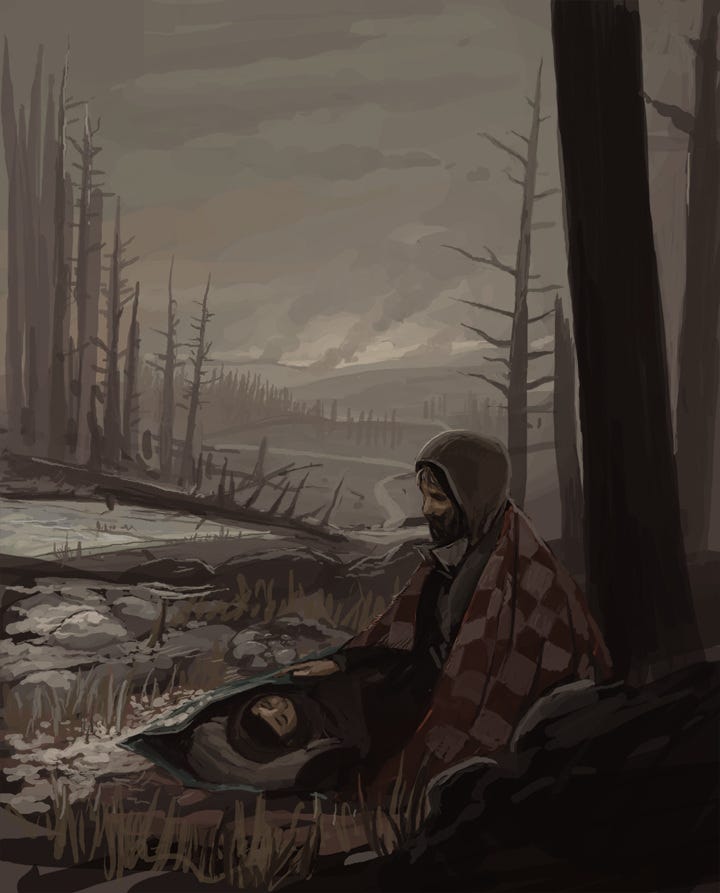
Once upon a time, I believed that Cormac McCarthy was a paradigmatic example of the nihilism that destroys hope in our world. When I first confronted his work, I was in an English class on modern American literature. The professor effectively made the argument that the mother in The Road–who kills herself so that she does not have to suffer through the post-apocalyptic wasteland, leaving her husband and son behind–was the more reasonable character in the novel. To this wimpy academic, she was the hero (!!).
The primary argument was that nothing that she could possibly do would matter: she could not defend herself or her son in a world governed by roving gangs of thieves and cannibals. What is the use?
I tried to explain that, perhaps, she has an important role to play: to preserve love in the husband’s and boy’s hearts in a loveless world.
Crickets. From my fellow students who had imbibed this drivel. From the professor, himself.
(My solution, of course, would not do. It would be to limit her bodily autonomy. Her right to annihilation. By telling her that some positive duty as a mother presses upon the soul, I had been presumptuous.)
That, is nihilism.
That was over ten years ago, and I did not quite have the words to express how wrong–metaphysically, epistemologically, and ethically–this argument was. So, I was convinced that this must have been the meaning of the text: self-annihilation = good.
I did not have the words to express that this argument ran entirely contrary to the “text’s view” as expressed by 1.) the actions of the “man” in the story, who nobly gives his life so that he may pass “the fire” onto his boy and 2.) the woman who adopts the boy and finally provides him with love and nurturing care at the end of the novel.
Ultimately, I have realized that I was right. McCarthy’s novel is an undoing of nihilism: it shows that even when our world is stripped of hope, we may find meaning even in the bleakest situations, so long as we continue to carry the fire that burns in our hearts. In some sense, the self-annihilation of the boy’s mother is essential to the text: it strips the text even of hope, and asks us to imagine if we may carry the fire in an utterly loveless world.
Fatherhood in The Road offers a different vision of love that challenged me as a father when I read it after the birth of my son.
In The Road, fatherhood is not a sentimental relation but a metaphysical burden assumed in the aftermath of civilizational collapse. From the novel’s opening sequences, as the man and the boy move through a burned and ashen landscape, the father’s consciousness is wholly ordered toward the child’s survival. As I argued in a previous essay, when life is stripped to its necessities and loneliness seems inevitable, when time contracts, we can still find meaning (perhaps the greatest joy and meaning, if Dostoevsky is correct).
It is in this context—after nights of fear, scarcity, and the constant threat of annihilation—that McCarthy introduces one of the novel’s most arresting reflections: as the father watches the boy sleep, he realizes, “He knew only that the child was his warrant. He said: If he is not the word of God God never spoke.” The moment arises from exhaustion and proximity to death. The father’s thought emerges precisely because nothing else remains to justify endurance. The boy becomes a living covenant, not merely a dependent but a revelation that compels the father to continue. What appears as love is thus inseparable from obligation, and what appears as obligation is infused with a theological intensity that the ruined world denies.
This sense of obligation becomes clearer in episodes in which the father must actively interpret the world for the boy, particularly in moments of danger or moral confusion. Early in their journey, after they narrowly avoid hostile survivors on the road, the boy begins to ask questions about who they are in relation to others. It is in this context—amid fear, hiding, and the constant need to distinguish themselves from cannibals—that the father introduces the language of moral identity: “We’re the good guys… And we’re carrying the fire.” This statement is not offered in comfort but in response to the boy’s dawning awareness that survival often requires the ability and willingness to kill. When the boy later presses the man, asking what it means to carry the fire and whether it is real, the father’s answer—“It’s inside you. It was always there. I can see it”—emerges as an attempt to stabilize the child’s moral imagination in a world that offers no external confirmation of goodness. The fire, then, is not a concept explained in the abstract but a truth asserted under pressure—a deeper truth: “I CAN SEE IT” (!!!)—spoken so that the boy may continue to act as though goodness still exists, though, externally, he frequently sees its inversion.
The strain on this moral framework becomes most evident in episodes in which the father’s instinct for survival conflicts with the boy’s instinct for mercy. After they are robbed by a desperate thief who takes their supplies, the father catches him, forces him to strip, and leaves him exposed to the cold. The act is brutal but intelligible within the father’s logic: without their belongings, the boy will die. Yet it is precisely in the moment when the father has secured their survival, that the boy begins to cry and protest. The boy insists, “He’s going to die… Can’t we help him?” The boy’s moral response forces a reevaluation of the father’s earlier claims about being “the good guys.” Under the weight of the child’s grief, the father relents, returning some of the man’s clothes, though not without hesitation and lingering severity. A father must continually reconcile his actions with the moral language he has given his boy. He must respond to his heart, which now walks around outside of his body, and the demands leveled by that heart to keep him from going too far in his violence, even if that violence is justified. In forcing this moral dilemma, McCarthy suggests that the fire is not something the father simply guards but something he must repeatedly rediscover through the boy’s uncorrupted sense of justice.
Language itself becomes one of the primary arenas in which this paternal responsibility is exercised, particularly as the external world loses not only its structures but its vocabulary. In passages describing the desolation around them, McCarthy notes that “the names of things [are] slowly following those things into oblivion,” a reflection that emerges as the father and son pass through landscapes where objects have lost their function and familiarity. It is against this backdrop that the father continues to name, explain, and narrate, even when naming–the command given to Adam in the Garden–seems futile. When language loses its anchor in civilization and reality, actions matter immensely. This conveys a deep truth that our English professors would do well to recognize and reflect on: even when language has been stripped of meaning, actions convey a moral reality. The boy can recognize that killing is morally untenable, even when a chaotic world demands it. Violence may be justified in particular circumstances, but it must be limited for the survival of man’s soul.
In such a world, how does a father educate his son? He tells him stories. When the boy asks whether the stories the father tells are true, the father replies, “Those stories are true stories. Everything in them is true.” His statement reflects less a commitment to factual accuracy than to moral coherence. The boy anxiously and frequently asks, “Do you think that it’s still there? The good guys?” The father reassures him, “Yes.” What makes him believe that this is true? “We’re still the good guys.” So long as there is one good man who continues to carry the fire forward, “it’s still there.”
These assertions function as acts of resistance against the collapse of meaning; through language, the father sustains a moral world that no longer has material support.
The culmination of this paternal vocation occurs in the father’s final illness, when his physical decline forces a transfer of responsibility to the boy. As he lies dying, aware that he can no longer protect him, the father returns to the language that has structured their relationship, telling him, “You have to go on… You have to carry the fire.” This is not instruction given in strength but in utter weakness, when the father’s authority is reduced to words alone. Because he has taught the boy words through stories and tied those stories to personal action, the words matter. The father has created something from nothing: that something exists in his son’s heart and soul, and informs the son’s moral vision. This moral vision will be the way in which he survives through his son, and the way in which the good perseveres through his son. He has lit a light in the boy's heart in the midst of darkness, and the hope is that the boy will shine that light in the grim world as he moves into a new family.
When the boy, seeking reassurance, asks again whether the fire is real, the father repeats, “It’s inside you. It always was.” The repetition transforms what was once a paternal claim into an inherited truth, one that the boy must now carry without external confirmation. In the novel’s closing movement, when the boy encounters another family and is asked whether he is one of the good guys, his ability to answer affirms that the father’s task has been fulfilled.
To “be the man” is not merely to protect but to transmit: to carry meaning to the point where it can survive one’s own extinction.
Thanks for writing. I read some of CS Lewis recently in the Abolition of Man and he discussed how it is our duty to keep man alive by adhering to universal values and truths and passing them down to each subsequent generation.