
Intro
Dreaming to Dostoevsky

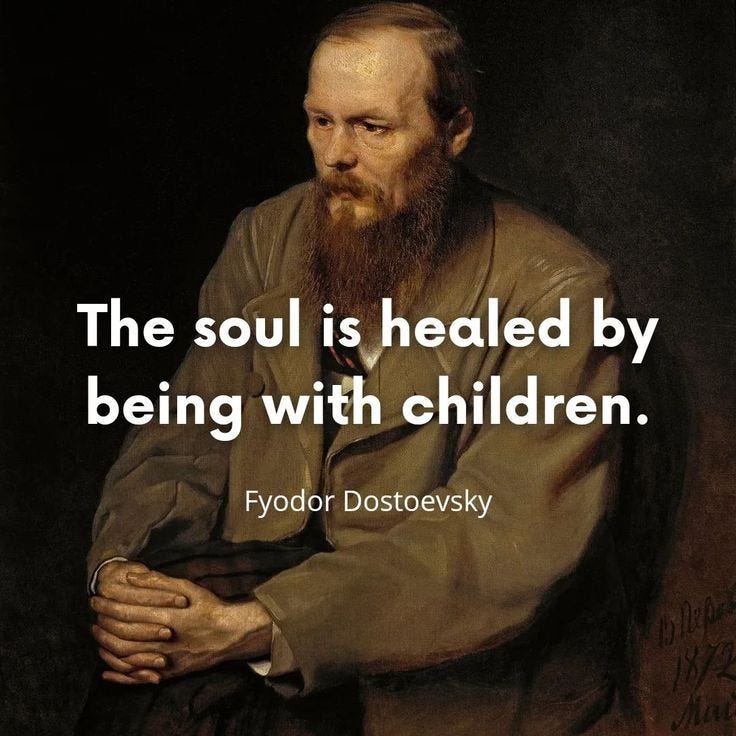
This Substack is inspired by my son. Its subject matter will be love, poetry, and parenting.
As a new father and a teacher, I have come to see that much of my reading will now take place under unusual hours and unusual conditions. I will be reading Dostoevsky late at night while my son, Cal, sleeps in my arms. I will be listening to music while the house is quiet and the ordinary sense of time loosens its grip. I thought I might keep a record of these moments—of what it means to read demanding literature while assuming responsibilities that are no longer theoretical—and I thought others might want to read along. We will begin with analyses of Dostoevsky and the songs I sing to Cal. Beyond that, I do not know exactly where the path will lead.
I love returning to Dostoevsky because he takes life seriously. Not politely or abstractly, but from a vantage that, at times, becomes difficult to bear. “Dreaming to Dostoevsky” will be a place to think through the way in which poetry informs love, fear, birth, rebirth, and responsibility. Fitting neatly with the theme of this new stage of life, I won’t have much concern for staying in neat categories.
Get on with the story, Dad.
Dostoevsky’s seriousness was not abstracted from the demands of living in life's grip; it was forced on him. In 1849, he was arrested for his involvement with the Petrashevsky Circle and sentenced to death. He was led out with other prisoners, tied to a post, and made to wait while the rifles were prepared. He waited. He thought. He was ready to meet his maker. He was, oddly, at peace with that.
Only at the final moment was the sentence commuted. The experience left him convinced that something essential about life can only be learned when time becomes scarce. That conviction appears again and again in his novels, nowhere more clearly than in The Idiot.
In The Idiot, Prince Myshkin recounts the experience of a man who knows he is about to die:
“He remembered that he had five minutes left to live. He said that those five minutes seemed to him an infinite space of time, an immense wealth, and that in those five minutes he could live so many lives that there was no need yet to think of the last moment; and he even distributed his time beforehand. He decided that two minutes would be enough for him to take leave of his comrades, two minutes more to think for the last time of himself, and one minute to look around him for the last time.”
The passage is striking not only for its emotional intensity but also for its precision. The condemned man does not panic. He organizes his time. He allocates it. He treats each remaining minute as something that can be meaningfully dispensed with. What Dostoevsky is describing here is not valiant courage or nihilistic resignation, but concentrated attention under pressure. Time, usually passed through without reflection, becomes a moral resource. Each minute has weight, and the man feels responsible for how it is spent.
This is not a mere poet’s dream. This is true for us as well.
What is especially important is that the man does not fantasize about escape or imagine future achievements. His concern is with presence: with looking, with remembering, with saying goodbye. These are simple things, but they become meaningful through that intense concentration (a great American poet once said, “Be a Simple Kind of man”). The narrowing of time produces a narrowing of concern, but also a deepening. Life becomes concentrated rather than diminished. Dostoevsky is suggesting that beauty and seriousness do not come from having more, but from having less.
This theme appears again in Crime and Punishment, but in a more troubling register. Raskolnikov reflects on a thought he has encountered somewhere, one that refuses to leave him:
“Where is it I read that a man condemned to death thinks or says, an hour before his death, that if he had to live somewhere high on a rock, on such a narrow ledge that he would only have room to stand, and the ocean, eternal darkness, eternal solitude, eternal tempest around him—if he had to remain standing on a space no bigger than a square yard for his whole life, a thousand years, eternity—he would rather live so than die at once?”
Here, Dostoevsky strips life down to almost nothing. No comfort, no progress, no relief. Only consciousness itself, sustained against annihilation. And yet that bare existence, that God’s gift, is still preferable to death.
The passage is unsettling because it refuses consolation. It does not claim that life is good because it is happy or meaningful in any ordinary sense. It claims that life is good because it is life. Consciousness itself carries an absolute value once its disappearance becomes unavoidable.
Before I became a father, I read these passages as psychological character studies. They seemed to describe extreme states that, while fascinating, were far removed from my more ordinary experience. After my son was born, they began to feel less distant.
Get on with it!
I did not feel prepared for fatherhood. I did not know how anyone could manage it without giving something up that mattered. There were a lot of things in my life that mattered a lot, that I didn’t want to give up. There still are; those things are still there.
I worried about what I would have to sacrifice, about whether I would lose myself, about whether I would fail in my work. I wondered how it was possible to care deeply about one’s family and one’s vocation without doing injustice to one or the other. These questions were not only dramatic, but they were also persistent, and they reflected a genuine uncertainty about whether I was equal to what was being asked of me.
Later, something emerged alongside that uncertainty. Call it grace, call it a superpower; whatever it was, it remains a mystery to me. When I said, in the simplest possible terms, that I loved my wife and my child and would fight for them no matter the cost, something shifted. The fear did not disappear, but it was reordered. It became energy. That energy still coarses through my veins. Responsibility imposed a structure on my attention in much the same way Dostoevsky describes time being structured by the imminence of death.
Cal’s birth involved thirty-four minutes of active labor (thirty-four was his grandpa’s baseball number, by the way). That number still surprises me. Those minutes contained more intensity than I would have thought possible in such a short span of time. Pain, fear, effort, and relief were compressed into an experience that resisted ordinary measures of duration. Time slowed. It thickened. What mattered was not how long it lasted, but that something irreversible was taking place. A life had begun, and with it a set of obligations that could not be deferred.
What about Dostoevsky?
That experience helped me understand Dostoevsky’s five minutes. Not because birth resembles death, but because both reveal what time actually contains when abstraction falls away. Thirty-four minutes were enough to hold an entire moral transformation. They were enough to reorganize my sense of responsibility and attention.
Now, when I hold my son at night while he sleeps, five minutes feels sufficient for all of life, yet insufficient: I never want to leave him.
It is enough time to register the seriousness of loving someone who depends on you completely. It is enough time to understand in an instant, without sentimentality, that you would give your life without hesitation if that were required. It is enough time to see how much of life’s meaning is already present in moments that appear small and repetitive.
Dostoevsky understood that love and mortality give time its density. Without them, time becomes something we pass through distractedly. With them, even brief moments resist being exhausted. Modern life tends to insulate us from this seriousness. We know, in theory, that life ends and that love demands the best within us, but we are rarely forced to feel either with much urgency.
Dostoevsky’s work forces us to confront both of these serious matters. His works are a shock to our intellectual system. Fatherhood has done something to my heart that Dostoevsky’s works have done to my brain.
This Substack will be written from that place: the heart. It will be a record of reading serious literature while trying to live a serious and intentional life as a father; of thinking about love, responsibility, and time not as abstractions but as realities open to us. It will be shaped by the experience of holding a sleeping child and reading a writer who knew what it meant to face death consciously. Dostoevsky changed the way I read and think, and Cal has changed the way I intend to live and love.