
Too Many Raskolnikovs
On fatherhood and habitual self-loathing, Part II

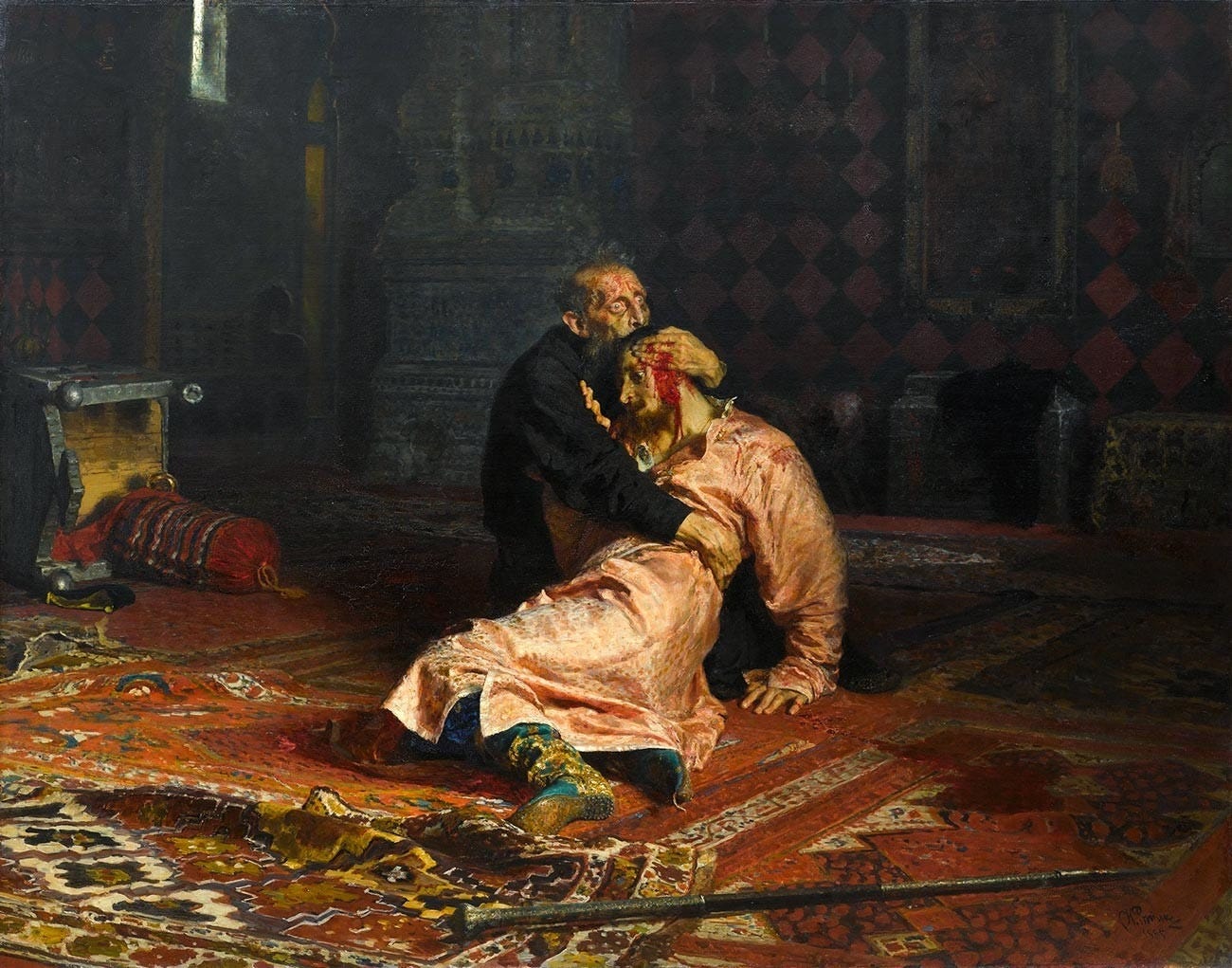
[Photo credit: Ilya Repin. Ivan the Terrible and his Son Ivan, November 16, 1581 (1883-85). This painting depicts the aftermath of Ivan the Terrible striking his son during an argument. This painting wrote or rewrote history. It is now generally believed that Ivan the Terrible’s son died from his father’s blow]
Don’t be a Marmeladov, dad. If you are, you might raise a prostitute or an axe murderer.
Sins of the father
Marmeladov appears only briefly, and his character is decisively set forth. Though he is a small man, who seems to play a small role in the novel, his moral character drives much of the plot of the novel. His words and deeds have consequences for many involved.
Though in my last post, I argued that men should despise being pitiful, Marmeladov has no shame with respect to his pitiful moral character. “Such pity as ours must not be despised,” he says, after recounting how his children cry for bread while he drinks away his self-inflicted personal troubles.
He does not speak as a man seeking moral amendment, but as one wallowing in his abasement. He apologizes, “I drink because I suffer, and I suffer because I drink.” He transforms his moral degradation into a closed moral system. He knows exactly what he does, but he doesn’t have the ability to turn his life around, to convert himself and turn away from his sin.
Dostoevsky does not linger on Marmeladov; he is an incredibly small man. He does not dwell on him. Marmeladov’s significance lies not in his own future (as he is aware, he has no future prospects and no upward trajectory) but in the effects of his actions and moral character upon those he supposedly loves. There is nothing more to say of him, and his words are not worth recounting.
His daughter, Sonya is much stronger and much more interesting. “Bravo, Sonya!” Raskolnikov says. He hasn’t yet met her, but he already senses that she is stronger than her spineless father. Yet, he doesn’t understand the source of her strength.
I digress, but I cannot help speaking of her: I love Sonya (The Russian name Sonya or Sonia derives from the Greek Sophia, meaning wisdom; the Orthodox meaning of the name is something like “holy wisdom”).
The point is that scoundrel fathers create weeping and hungry babes not only by neglect, but by their choices and moral example. They teach their children that conscience can be deadened, that responsibility can be ignored, and that suffering excuses everything. In short, they show their children that they do not truly love them. The damage of a father’s moral character does not end with the father. It reappears, transfigured, in the sons.
Pitiful sons
Raskolnikov is one such son—not in fact, but in spirit. From the opening pages of Crime and Punishment, it is clear that he does not know himself. He is self absorbed, so much so, that he refuses to know the man he should become: “He had become so completely absorbed in himself and isolated from his fellows that he dreaded meeting not only his landlady, but anyone at all.” This dread is not mere shyness. Raskolnikov is divided. One part of him is capable of tenderness and sacrifice; another surveys humanity with cold abstraction. He lacks moral clarity and integity and his soul disintegrates throughout the novel.
His name announces his moral condition. Raskol means schism, rupture, a tearing apart. It is a word heavy with historical resonance in Russia, recalling religious division and broken communion. A raskolnik is not simply a rebel, but one who rebels against wholeness. In particular, a Russian raskolnik rebelled against the wholeness and integrity of the Orthodox Church. Raskolnikov’s crime will come later; his fracture is originary.
The pressure that sharpens this division arrives in his mother’s letter. “You are our only hope, Rodion Romanovich,” Pulcheria Alexandrovna writes. She calls him her “faith,” “only hope,” and “trust.” Words matter. She tells him this at both the beginning and end of the letter. The sentence he has presumably heard over and over again is demanding and devastating in its simplicity.
This love is inseparable from expectation. Yet, she knows not what she does. He is not merely cherished; he is required, he feels. Defined by his mother as the only hope, he feels that he must redeem familial sacrifice, justify earthly suffering, and give meaning to deprivation.
He thinks he must bear the cross. To be loved he must be worthy of the mantle “only hope.” He tries to become a hollow substitute for Christ. He must speak one new word and take one new step, or else he is a scoundrel like all other men.
“Home is where the heart is”
This is why the novel opens not in stasis but in movement. “He walked slowly, as though in hesitation,” Dostoevsky writes, as Raskolnikov leaves his garret and goes toward the bridge. When he crosses it, he experiences a sudden lightness, “as though a burden had been lifted from him.” The image is unmistakable. He walks above the water, soaring above the recurring sign of baptism. This crossing is his private exodus. To be his mother’s hope, he believes he must become a savior.
Concomitant with his inherited God complex is his great cowardice. Raskolnikov is possessed by fear of his plump little landlady. “He was more afraid of meeting the landlady than of anything else.” Dostoevsky calls the fear “morbid.”
In Russian literature, the landlady is never a mere woman. She is the figure of obligation and the reminder of debt and reckoning. After the murder, Raskolnikov is called to the police station because his landlady turns him in. The officer tells him “you don’t pay your debts.” Raskolnikov is shocked that she would report him. “But she’s my landlady!” He cries.
Raskolnikov’s landlady stands where conscience stands, but he has stifled his conscience. Raskolnikov owes her rent, but more than rent, he owes an answer for his life. Instead of confronting her, he skulks, listens at doors, and calculates how to avoid her. Conscience becomes a logistical, arithmetical, problem of evasion rather than a moral summon. He avoids the call at all costs. He cannot bear to be at home with himself.
“A friend is another self”
Yet Dostoevsky is careful to show what the coward misses as he crosses over to seize strength and world historical greatness while cowering from his old landlady.
At the end of Book I, Chapter V, he suddenly remembers Razumikhin. “He recalled that he had a friend, Razumikhin,” and “at once rejected the thought of going to see him.” The refusal is instinctive. “He did not want to go; he felt that he could not.”
Razumikhin derives from razum—reason, sense, judgment—but not in the narrow technical sense. Razum is the capacity for moral clarity achieved through logos. Razumikhin argues, jokes, contradicts himself, endorses playful lying in the search of truth, yet remains whole: integrated.
To go to reason would require Raskolnikov to speak, to expose his confusion, to submit to sense: to account for himself. It would require humility. He recoils. Reason, which binds and confines man to his proper sphere, is rejected.
What Raskolnikov refuses in reason and conscience, he replaces with calculation. From the first chapter Dostoevsky emphasizes this tendency. “He had calculated the number of steps from the gate to the old woman’s apartment.” Distances, timings, angles: “he had thought it all out beforehand.”
This is not mere cleverness. It is a form of moral displacement. Calculation promises control without self-knowledge. It is the education of the modern schoolroom, where arithmetic is perfected while formation of character and self-knowledge is neglected.
Raskolnikov knows how to think, but not how to stand before himself.
And yet his heart refuses to be silent. “His heart beat violently,” Dostoevsky tells us again and again, not from exertion but from pressure and the pangs of conscience. When the thought of the crime becomes distinct, “a strange, almost physical feeling of loathing came over him,” and later “his heart seemed to contract painfully.” This is conscience speaking in the body.
Though he tries to ignore his landlady, Raskolnikov does not lack conscience. Because he ignores it, he is tormented by it. But he has never been taught how to listen. “He felt suddenly ill,” “he felt a terrible inward chill,” and he explains it all away. He rationalizes. The final evasion of conscience is physiological reduction.
The father figures
Here, the absence of the father becomes decisive. Fathers are meant to be moral teachers, in word and in deed. They teach sons how to endure shame without self-destruction and how to heed conscience. They model and teach how to bear responsibility without despair.
Marmeladov drinks away that authority. We know that Raskolnikov once had a father. His father gave him a watch with a picture of the world inscribed on the back. He pawned it to the woman he murders. Raskolnikov inherits not guidance, but pressure: to save, to redeem, to justify suffering without instruction in how to live truthfully.
Where razum is absent, raskol takes its place. The soul fractures. Intelligence ascends, yet wisdom withers.
The names in the novel encode some of Dostoevsky’s deepest claims. Razumikhin embodies reason and the possibility of integration: thought bound to friendship and speech, and the cultivation of moral judgment. Raskolnikov’s intellect leads to a schism in the soul and disintegration. In the protagonist, calculation is severed from conscience and theory is divorced from wisdom (sophia). In refusing Razumikhin, Raskolnikov chooses raskol over razum and Sofya. He chooses division over sense and a “new” kind of knowledge over friendly reason and holy wisdom. From that choice flows everything else.
Too many scoundrel fathers leave behind sons burdened with false saviorhood and no moral formation. Too many fathers inadvertently cultivate hubris instead of humility and a deep sense of conscience in their children. Just go to a 4th-grade flag football game.
Too many Marmeladovs create too many Raskolnikovs: divided men who believe they must become extraordinary in ordinary and ultimately meaningless matters to merit a father’s love. Such an aim produces a young man who evades conscience and turns to cunning. These young men may turn outward to find meaning rather than look within themselves.
What is needed is the quiet, forgotten work of moral formation: teaching young men to know themselves and attend to their consciences before they strive for greatness or seek to save the world to become worthy of love.